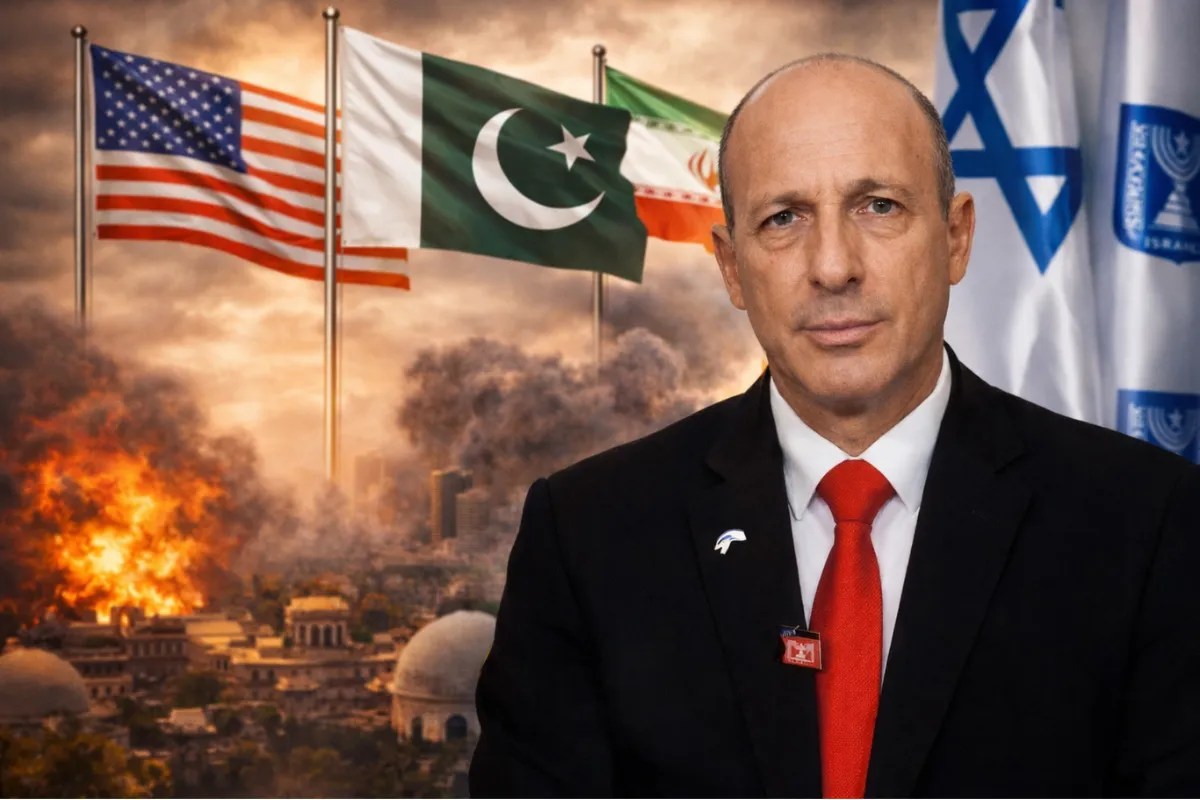
The recent escalation in rhetoric from Israeli diplomatic circles regarding Pakistan’s role in regional stability is not a mere product of momentary friction but the surfacing of a long-standing structural misalignment. Israel’s vocal skepticism toward Islamabad—specifically in the context of peace negotiations—functions as a risk assessment based on three distinct vectors: asymmetric warfare sponsorship, nuclear proliferation history, and the absence of a normative bilateral framework. To understand why Israel views Pakistan through a lens of inherent untrustworthiness, one must examine the operational mechanics of Pakistan’s foreign policy, which often prioritizes non-state actors as instruments of statecraft.
The Dual-Track Security Paradox
Israel’s strategic doctrine is built on the concept of "Begin Doctrine" (preventative strikes against existential threats) and a reliance on absolute clarity in diplomatic commitments. Pakistan, conversely, operates under a dual-track security paradox. On one track, Islamabad engages in formal international diplomacy; on the other, its military-intelligence complex maintains deep-seated ties with extremist elements to project power in the Indian subcontinent and the Middle East. For a more detailed analysis into similar topics, we suggest: this related article.
This structural duality creates a credibility deficit. For Israeli intelligence, the concern is not just the presence of hostile actors within Pakistan, but the state’s inability—or unwillingness—to decouple its national security strategy from these groups. When Israel labels Pakistan as a "mastermind of terror," it is quantifying the logistical and ideological support pipelines that link South Asian militant networks to broader anti-Israel movements.
Three Pillars of Institutional Trust Deficit
The Israeli refusal to trust Islamabad is rooted in three quantifiable pillars that define the relationship. For further background on the matter, extensive analysis can also be found on The New York Times.
1. The Proliferation Risk Profile
The legacy of the A.Q. Khan network remains a central pillar of Israeli suspicion. Although the network was officially dismantled, the technological blueprints and centrifuge designs that leaked to Iran and Libya created a permanent scar on the global non-proliferation landscape. From the perspective of Israeli defense planners, the Pakistani state’s "oversight" of its nuclear assets is a variable, not a constant. The risk of technology transfer to non-state actors or hostile regional powers remains the highest-weighted threat in Israel’s regional assessment.
2. The Ideological Export Model
Unlike many Arab states that have moved toward a pragmatic, post-ideological stance via the Abraham Accords, Pakistan’s domestic legitimacy remains tied to a specific religious-nationalist identity. This identity is frequently leveraged to provide moral and political cover for groups such as Lashkar-e-Taiba (LeT) or Jaish-e-Mohammed (JeM). Israel perceives these groups as ideological cousins to Hamas and Hezbollah. The connection is not necessarily tactical, but rather a shared methodology of utilizing civilian environments to launch asymmetric attacks.
3. The Lack of Sovereign Accountability
A major bottleneck in any potential "peace talk" involving Pakistani influence is the fragmented nature of its power centers. In a standard diplomatic model, the civilian government signs treaties. In the Pakistani model, the civilian leadership often lacks the authority to enforce these treaties against the interests of the security establishment. Israel views negotiation with Islamabad as a low-yield exercise because the "signer" of an agreement does not control the "enforcer" of the policy.
The Operational Link Between Gaza and South Asia
The specific timing of Israel’s "explosive statement" coincides with shifting dynamics in the Levant. Israel is currently engaged in a multi-front conflict against an Iranian-led "Ring of Fire." Within this context, Pakistan is analyzed as a potential strategic depth provider for Israeli adversaries.
The mechanism of this threat is primarily financial and logistical. Intelligence reports have frequently highlighted the movement of funds through the "Hawala" system, which connects South Asian financial hubs to the Levant. While the Pakistani state denies direct involvement, the lack of rigorous anti-money laundering (AML) controls—as evidenced by Pakistan’s recurring issues with the Financial Action Task Force (FATF)—suggests a permissive environment for the financing of groups that target Israeli interests.
The Cost Function of Diplomatic Engagement
For Israel, the cost-benefit analysis of engaging with Pakistan yields a negative result. The potential benefits (symbolic recognition by a major Muslim nuclear power) are outweighed by the risks (intelligence leaks to Iran, legitimizing a state that supports asymmetric warfare).
This creates a "Stability Trap." If Israel attempts to thaw relations, it risks alienating its primary strategic partner in South Asia, India. The Indo-Israeli partnership is built on high-trust defense cooperation and counter-terrorism intelligence sharing. Any overture toward Islamabad would degrade the quality of this partnership, which is currently the cornerstone of Israel’s Eastern strategy.
Deconstructing the "Peace Talk" Mirage
When headlines suggest "peace talks" involving Pakistan, they often ignore the tactical reality that Pakistan has no formal recognition of Israel. The talks mentioned in recent discourse are typically "track-two" diplomacy or mediated through third parties like Qatar or Turkey. Israel’s explosive rhetoric is a deliberate attempt to collapse these "track-two" channels before they can gain momentum.
By publicly branding Pakistan as untrustworthy, Israel signals to its Western allies—specifically the United States—that any attempt to include Pakistan as a mediator in Middle Eastern affairs will be met with categorical resistance. This is a move to protect the integrity of the Abraham Accords framework, which favors monarchies and centralized states over the decentralized and volatile power structures found in Islamabad.
The Intelligence Bottleneck: A Case of Conflicting Interests
The primary friction point between the Mossad and Pakistan’s ISI (Inter-Services Intelligence) is the divergence of their primary targets. Israel’s focus is on the Iranian Revolutionary Guard Corps (IRGC). Pakistan’s focus is on Indian influence in Afghanistan and Kashmir. However, the IRGC has successfully cultivated ties within the Pakistani Shiite population and certain wings of the military to facilitate the "Zainabiyoun Brigade."
This brigade, composed of Pakistani nationals fighting in Syria under Iranian command, represents a direct physical threat to Israeli interests. The Pakistani state’s failure to prevent its citizens from being recruited into Iranian-led militias makes it, in the eyes of Israeli defense officials, a silent partner in Iran’s regional expansionism.
Structural Incentives for Continued Hostility
There are zero structural incentives for Israel to change its stance on Pakistan in the current geopolitical climate.
- Military Logic: Maintaining Pakistan as a "hostile entity" justifies the deepening of the tech-defense pipeline with New Delhi.
- Diplomatic Logic: It reinforces the narrative that Israel only negotiates with "stable, sovereign actors," thereby pressuring other nations to centralize their security apparatuses before seeking normalization.
- Intelligence Logic: Publicly calling out Pakistan allows Israel to bypass traditional diplomatic niceties and speak directly to the global community about the dangers of state-sponsored non-state actors.
The lack of a shared border means that Israel and Pakistan are "geopolitical ghosts"—they rarely clash physically, but their interests collide in every major international forum and proxy theater. This distance allows for a high degree of rhetorical escalation with low immediate risk of conventional war.
Strategic Forecast: The Shift Toward Exclusion
The trajectory of Israeli-Pakistani relations is moving toward a state of formal exclusion. As the world bifurcates into "Status Quo Powers" (those who support the current international order) and "Revisionist Powers" (those who seek to upend it through proxy warfare), Pakistan’s inability to commit to a single camp makes it a liability for Israel.
Israel will continue to leverage its "untrustworthy" narrative to achieve three specific outcomes:
- Normalization Deadlock: Ensuring that any future expansion of the Abraham Accords excludes states with decentralized military control.
- Counter-Proliferation Pressure: Using Pakistan’s history as a "bad actor" in the nuclear space to maintain international sanctions and oversight on Iranian nuclear ambitions.
- Indo-Pacific Alignment: Solidifying its role as the premier technology and intelligence provider to India, thereby encircling Pakistan with a sophisticated "high-trust" defense network.
The path forward for Israel does not involve a "peace process" with Islamabad. Instead, it involves the containment of Pakistani influence in the Middle East and the systematic exposure of the financial and ideological pipelines that link South Asian extremism to the borders of the Levant. The explosive statements coming out of Jerusalem are not emotional outbursts; they are calculated signals that the era of strategic ambiguity regarding Pakistan’s role in global terror is over. Israel is now pricing the "Pakistan Risk" into its total security equation, and the result is a permanent posture of diplomatic and intelligence-led hostility.