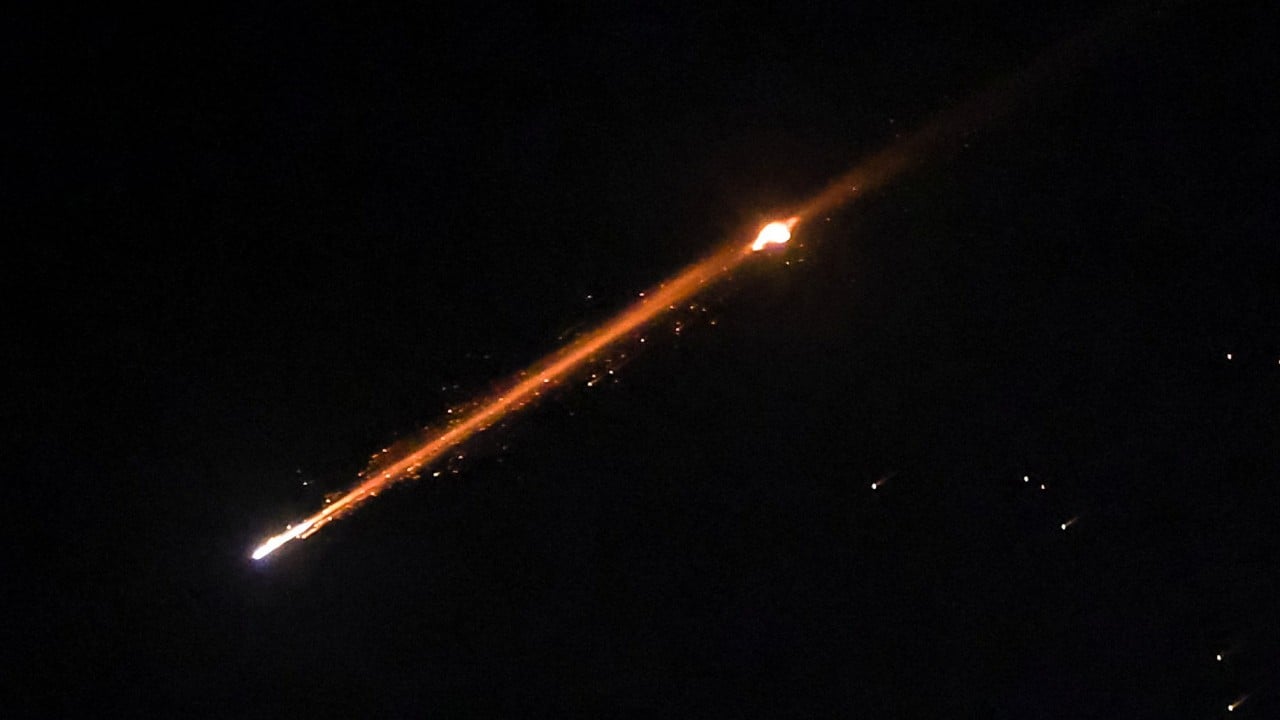
The shift in Middle Eastern ballistic warfare is defined not by the quantity of warheads, but by the transition from liquid-fuel dependency to solid-propellant mobility. This technical evolution has fundamentally altered the "Time-to-Launch" (TTL) variable, effectively neutralizing traditional pre-emptive strike doctrines. When missiles can be transitioned from deep-storage canisters to active firing sequences in minutes rather than hours, the overhead window for satellite detection and kinetic interception closes. The result is a strategic environment where the cost of defense scales exponentially while the cost of offensive saturation remains linear.
The Technical Architecture of Persistent Threat
The operational utility of Iran’s current missile inventory—specifically the Fattah, Kheibar Shekan, and Haj Qassem variants—relies on three distinct engineering pillars that circumvent Western and regional integrated air defense systems (IADS).
1. Solid Propellant Stability and Readiness
Liquid-fueled missiles, like the older Shahab series, require a volatile fueling process immediately before launch. This creates a "thermal and logistical signature" easily detected by persistent overhead surveillance. Solid-fuel motors, conversely, utilize a pre-cast grain of fuel and oxidizer.
This allows for:
- Instantaneous Deployment: The elimination of fueling trucks and specialized hazardous material (HAZMAT) teams.
- Encapsulated Storage: Missiles remain in climate-controlled canisters for years, maintaining high reliability rates.
- Mobile Launch Platforms: Solid-fuel systems are lighter and more rugged, allowing them to be mounted on Transporter-Erector-Launchers (TELs) that resemble standard commercial freight trucks.
2. The Terminal Maneuverability Function
Modern Iranian delivery systems have decoupled the reentry vehicle (RV) from the booster stage earlier in the flight path. The introduction of Maneuverable Reentry Vehicles (MaRVs) and Hypersonic Glide Vehicles (HGVs) introduces non-ballistic trajectories. Standard interceptors, such as the Patriot PAC-3 or Arrow 3, calculate intercept points based on predictable Keplerian arcs. When a warhead utilizes aerodynamic fins or thrusters to change its vector within the atmosphere, the interceptor's internal guidance reaches a "divergence limit"—where it can no longer generate the necessary G-force to catch the target.
3. The Asymmetric Cost Curve
The financial and logistical imbalance of interception is the most significant strategic variable. A Standard Missile-3 (SM-3) or an Arrow-3 interceptor costs between $10 million and $30 million per unit. The estimated unit cost of a solid-fueled Iranian missile like the Kheibar Shekan ranges from $150,000 to $500,000. For an adversary to achieve a 90% interception rate against a 100-missile salvo, the defense must expend a minimum of $1 billion to $3 billion in munitions. The attacker’s expenditure remains below $50 million. This 20:1 to 60:1 cost-to-kill ratio ensures that even a technically successful defense leads to economic and logistical exhaustion for the defender over a protracted conflict.
Strategic Decentralization and Tunnel Warfare
The "hunt" for Iranian missiles is complicated by the geographic and structural shift toward "Missile Cities"—underground, hardened storage and launch complexes. These facilities utilize horizontal and vertical tunneling to ensure that launch sites are not fixed.
- Underground Launch Tubes (ULTs): These are pre-surveyed, reinforced launch points that allow a TEL to fire from a protected position and then retreat back into a tunnel network before satellite-revisit cycles occur.
- Decoy Proliferation: Iran has invested heavily in high-fidelity decoys that mimic the thermal and radar signatures of solid-fuel TELs. These distract defensive sensors and force the depletion of high-cost interceptors on non-threat targets.
- Geographic Distribution: The move from centralized launch pads to rugged, mountainous terrain in provinces like Kerman and Kermanshah utilizes natural terrain as a kinetic shield against standoff strikes.
The Kill Chain Breakdown: Detection vs. Interception
The traditional "Kill Chain"—Find, Fix, Track, Target, Engage, Assess (F2T2EA)—is broken by the speed of solid-propellant systems. When a missile is stored in a mountain tunnel and can be rolled out, fired, and returned to cover within 15 minutes, the "Find" and "Fix" phases of the chain are compressed beyond the capabilities of most current ISR (Intelligence, Surveillance, Reconnaissance) assets.
Synthetic Aperture Radar (SAR) satellites can see through cloud cover, but they cannot see through hundreds of feet of granite. The reliance on SIGINT (Signals Intelligence) to detect launch preparations is also failing as Iranian command and control (C2) shifts to fiber-optic, hardwired communication between missile sites, eliminating the detectable radio-frequency (RF) chatter associated with a countdown.
The Precision Revolution: CEP and Lethality
A missile's effectiveness is measured by its Circular Error Probable (CEP)—the radius within which 50% of the warheads will land. Early Iranian missiles had a CEP of 500 meters to 1 kilometer, making them "terror weapons" suitable only for targeting cities. Current generation solid-fuel missiles have achieved a CEP of 10 to 30 meters. This leap in precision is driven by:
- GPS/GLONASS Integration: Low-cost, commercial-grade satellite navigation modules hardened against electronic warfare.
- Inertial Navigation Systems (INS): Fiber-optic gyroscopes that maintain accuracy even when GPS is jammed.
- Terminal Seekers: Electro-optical (EO) or infrared (IR) sensors in the nose cone that identify a target during the final dive and adjust the fins for a direct hit.
This level of precision transforms the missile force from a psychological tool into a surgical kinetic instrument. It allows for the targeted destruction of specific hangars at an airbase, fuel storage tanks, or the command centers of integrated air defense systems.
Defensive Limitations and Logistical Bottlenecks
The current posture of regional and Western defense is built on "Deep Magazines," but the production rates of interceptors cannot keep pace with the production of solid-fuel missiles. A single factory in Iran can churn out dozens of solid-fuel motors per month using domestically sourced chemicals and carbon-fiber winding machines. Interceptors like the THAAD or Patriot require complex global supply chains for specialized electronics and high-performance guidance systems.
The second limitation is "Sensor Saturation." Even the most advanced AN/TPY-2 radar systems have a finite number of targets they can track and engage simultaneously. By using "Saturation Salvos"—launching more missiles than there are available engagement channels—an attacker ensures that a percentage of the warheads will reach their targets, regardless of the quality of the individual interceptors.
The Strategic Shift Toward Counter-Battery Warfare
As interception becomes less viable, the strategic focus must shift toward "Left-of-Launch" operations. This involves cyber, electronic, and kinetic attacks on the C2 and logistical infrastructure that supports the missile force before a launch occurs. However, the decentralization of Iranian missile units and the use of hardened, buried facilities make "Left-of-Launch" a high-risk, low-reward endeavor without massive and sustained aerial bombardment.
The regional security architecture is now facing a "Missile-Gap" not of numbers, but of reaction time. The proliferation of solid-fuel technology to non-state actors in Yemen and Lebanon further complicates the calculus, as it distributes a sophisticated, hard-to-track kinetic threat across multiple fronts.
Military planners must recognize that the "hunting" of mobile solid-fuel missiles is a legacy concept that no longer aligns with the speed of 21st-century propellant technology. The only viable path forward involves the development of high-energy laser (HEL) or microwave-based point defense systems that provide a near-infinite magazine and a significantly lower cost-per-shot. Until directed-energy weapons are deployed at scale, the strategic advantage remains firmly with the side that can produce and launch solid-fuel missiles at a fraction of the cost of their interception.
Establishment of a redundant, autonomous sensor network that operates independently of space-based assets—utilizing high-altitude long-endurance (HALE) drones—is the immediate tactical requirement to narrow the detection gap.