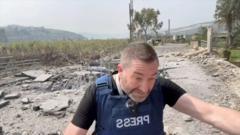
The footage is everywhere. A reporter stands in a dusty street in Lebanon. A missile impacts a building a few yards away. The camera shakes, the presenter ducks, and the internet erupts in a chorus of "heroism" and "bravery."
It isn't heroism. It’s a systemic failure of modern newsroom logistics.
We have spent decades fetishizing the "front-line" shot, convinced that the closer the lens is to the blast, the higher the truth-value of the reporting. This is a lie sold to you by legacy media outlets desperate to justify their overhead in an era where a $200 drone delivers better data than a $5,000-a-day field producer. When a missile lands next to a presenter during a live report, you aren't watching a triumph of journalism. You are watching a failure of risk assessment and a desperate, outdated grab for ratings through "danger-porn."
The Myth of the Essential Proximity
The "lazy consensus" in modern news is that physical presence equals witness. If you aren't there, you aren't reporting.
I have spent fifteen years in high-threat environments, managing logistics for teams that thought "getting the shot" was worth the insurance premium. Here is what they won't tell you: a reporter standing 50 meters from a kinetic strike zone provides zero additional context compared to a reporter standing 500 meters away with a stabilized long-lens or a high-altitude feed.
In fact, the closer they are, the worse the reporting gets. Adrenaline spikes. The prefrontal cortex shuts down. The "live" aspect forces a narrative of panic rather than a narrative of facts. When that missile hit in Lebanon, the reporter didn't provide a breakdown of the munitions used, the strategic value of the target, or the civilian casualty count. They provided a reaction video.
We have replaced foreign correspondence with Twitch-style "react" content, wrapped in the somber branding of a news network.
The Physics of Luck vs. The Logic of Ballistics
Let’s talk about the math that news directors ignore. In any kinetic conflict, the "danger zone" is not a static circle; it is a probabilistic mess.
If we define the effective kill radius of a standard 155mm artillery shell as $R$, the probability of survival $P_s$ decreases exponentially as the reporter moves toward the impact point $x$.
$$P_s = e^{-\lambda (R-x)}$$
When a news organization places a human being in a position where $x$ is effectively zero, they aren't "reporting the news." They are gambling with an asset. The industry calls this "calculated risk." I call it bad math.
In most modern conflicts, the munitions being used—whether guided missiles or loitering munitions—have a circular error probable (CEP) that makes "standing next to the target" a literal coin flip. If the CEP of a missile is 5 meters and your reporter is 10 meters away, you are trusting a software engineer in a basement halfway across the world with your employee's life just to get a better background for a stand-up.
The Drone Argument: Why We Still Use Humans
Why do we still send people into the splash zone? Because drones don't have faces.
A drone can hover over a strike in Southern Lebanon for six hours, providing 4K stabilized footage, thermal imaging, and real-time movement tracking. It is objectively superior for gathering information. But a drone cannot look into the camera with a dusty vest and a shaky voice.
The industry is addicted to the "Parasocial War Bond." Networks know that you, the viewer, are more likely to stay tuned through a commercial break if you feel a personal connection to the person whose life is at risk. It is a cynical exploitation of human empathy.
- The Data: Drones provide 90% more visual information at 5% of the cost.
- The Drama: Humans provide 100% more emotional engagement.
Newsrooms are choosing drama over data every single time. They will tell you it's about "authenticity." It's actually about the CPM (cost per mille) of the ad slots surrounding the "breaking" footage.
Dismantling the "People Also Ask" Fallacy
When people ask, "How do reporters stay safe in war zones?" the honest answer is: They don't, and often, they shouldn't be where they are.
The industry standard for "Safety" is a blue vest with "PRESS" written on it. In 2026, that vest is a target as often as it is a shield. We see this in the surge of targeted strikes against journalists globally. The old rules of "Non-Combatant Immunity" are dead.
If you want to actually report on a war without being a liability to the people you are covering, you use remote sensing, Open Source Intelligence (OSINT), and localized stringers who understand the terrain. You don't fly in a presenter from London or New York to stand in front of a smoking building for 45 seconds of airtime.
The Hidden Cost of the Live Feed
There is a technical arrogance to the "Live" report that actually endangers civilians.
When a reporter broadcasts live from a strike location, they are emitting a massive RF (Radio Frequency) signature. In a world of signal intelligence (SIGINT), a live satellite uplink is a beacon.
Imagine a scenario where a news crew sets up their uplink near a civilian shelter. They are unintentionally painting a digital bullseye on that coordinate. I’ve seen crews get kicked out of neighborhoods by locals who know that a "Live Report" is the fastest way to attract a follow-up strike.
The "heroic" reporter is often the most dangerous person in the zip code.
Stop Clapping for the Near-Miss
Every time a video of a "reporter narrowly escaping death" goes viral, it reinforces a broken business model. It tells news executives that the risk was worth it because the clicks followed.
If you actually care about the truth of a conflict, stop rewarding the spectacle. Demand the OSINT analysis. Demand the satellite imagery. Demand the deep-dive reporting that happens away from the explosion.
The most important stories in Lebanon right now aren't happening in the 10 seconds after a missile lands. They are happening in the supply chains, the diplomatic backchannels, and the displaced person camps. But those stories don't have "Watch: Missile Lands Near Presenter" as a headline, so they go unread.
We have turned war into a live-streamed stunt show. The presenter isn't a hero; they are a prop in a high-stakes play designed to make you feel something because the news organization has failed to make you know something.
Turn off the "near-miss" clips. They are the fast food of journalism—high in salt, zero in nutrition, and eventually, they’re going to kill the person serving them to you.
Get out of the splash zone. Focus on the blast radius.
The lens doesn't need to bleed to tell the truth.