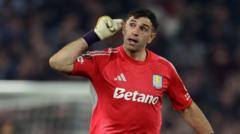
Aston Villa’s trajectory toward UEFA Champions League qualification is not a product of momentum or "grit," but a successful optimization of a high-line defensive trap and a transition-heavy offensive model. To understand why Villa is currently positioned to disrupt the established "Big Six" hierarchy, one must analyze the tactical trade-offs Unai Emery has accepted to maximize the efficiency of his squad. The margin for error is shrinking as the fixture density increases, yet the underlying metrics suggest that Villa’s position is a result of structural superiority rather than statistical variance.
The High Line as a Risk Reward Function
The defining characteristic of Villa’s defensive phase is the extreme height of their defensive line. This is a calculated gamble designed to compress the pitch and negate the opposition’s ability to build play through the midfield. The efficacy of this system is measured by the frequency of offside provocations versus the Expected Goals (xG) conceded through direct "through-ball" exploitations.
Villa leads the Premier League in offsides won by a significant margin. This is not a byproduct of passive defending; it is a proactive tactical tool. By holding a line near the halfway mark, Villa forces the opposition into a binary outcome:
- The attacker mistimes the run, resulting in a turnover of possession.
- The attacker beats the trap, creating a high-value 1v1 opportunity against the goalkeeper.
The logic here dictates that conceding a few high-value chances is preferable to conceding a high volume of medium-value chances. By squeezing the space in the middle third, Villa prevents creative midfielders from turning and facing the goal, which disrupts the supply chain to elite forwards. The "cost" of this system is an occasional heavy defeat when the timing of the line is fractionally off, but the cumulative effect is a reduction in the opponent’s total time spent in Villa’s defensive third.
Midfield Box Structures and Numerical Overloads
Emery utilizes a 4-2-2-2 or a 4-4-2 that morphs into a 3-2-5 in possession. The key to their progression lies in the "box midfield" created by two deep-lying pivots and two advanced playmakers who tuck inside from wide positions. This structure creates a persistent 4v3 or 4v2 advantage against traditional three-man midfields.
- The Pivot Function: The deep midfielders serve as the primary distributors, drawing the opposition press inward.
- The Half-Space Exploitation: By moving wide players into the "half-spaces" (the vertical lanes between the wing and the center), Villa forces opposing full-backs into a dilemma. If the full-back follows the winger inside, they leave the flank open for Villa’s marauding full-backs. If they stay wide, the interior playmaker receives the ball between the lines with time to turn.
This creates a "cascading failure" in the opposition’s defensive structure. Once the first line of the press is bypassed, Villa’s speed in transition becomes a lethal variable. The transition is not merely "fast-breaking"; it is a choreographed movement where the ball moves vertically through the center before being sprayed to the overlapping runners.
The Statistical Profile of Ollie Watkins as a Tactical Pivot
While traditional analysis focuses on Watkins’ goal tally, his primary value to the system is his role as a "spacer." His ability to run the channels does more than create shooting opportunities; it stretches the opposition’s center-backs vertically.
When Watkins makes a diagonal run toward the corner flag, he drags a defender with him. This creates a "vacuum zone" in the center of the pitch. Because Villa’s wide players are already tucked inside, they are perfectly positioned to sprint into the space Watkins has vacated. This "rotation of threat" makes Villa difficult to mark because the primary goalscorer is often the one creating the space for the secondary runners.
His defensive contributions are equally systemic. Watkins triggers the press not by running at the ball, but by cutting off the passing lane to the opponent’s strongest central defender. This forces the ball toward the "trap zones" on the touchline where Villa’s compact midfield can swarm the ball carrier.
The Bottleneck of Squad Depth and Fatigue Accumulation
The primary threat to Villa finishing the job is not tactical regression, but physiological depletion. Emery’s system demands high physical output from specific roles, particularly the "engine room" midfielders and the full-backs.
The drop-off in performance metrics between the starting XI and the rotational players is the central vulnerability. In a league where the top-tier competitors can rotate $50 million assets without a loss in systemic integrity, Villa operates on a narrower margin.
- The Substitution Lag: Data indicates that Villa’s defensive intensity (measured by PPDA - Passes Per Defensive Action) drops significantly after the 70th minute in games where the starting midfield has not been rotated.
- The European Tax: Competing in the Europa Conference League adds a cognitive and physical load that often correlates with a 10-15% reduction in high-intensity sprints in the subsequent domestic fixture.
To mitigate this, Emery has shifted toward a more "controlled" possession model in the second half of matches where they hold a lead. Instead of hunting for a third or fourth goal through transitions, they emphasize "defensive possession," keeping the ball in non-threatening areas to force the opponent to run, thereby conserving Villa’s own energy reserves.
The Financial Fair Play (PSR) Constraint as a Strategic Ceiling
The broader context of Villa’s rise is the Profit and Sustainability Rules (PSR). Qualification for the Champions League is not just a sporting achievement; it is a structural necessity for long-term competition. The revenue delta between the Europa League and the Champions League—roughly €40m to €60m depending on performance—represents the ability to upgrade the squad’s "floor" (the quality of the bench).
If Villa fails to secure a top-four or top-five finish (depending on the coefficient), they face a "strategic reset." The current wage-to-turnover ratio is sustainable only with the infusion of UCL broadcasting rights and gate receipts. Therefore, the final stretch of the season is a high-stakes financial pivot point. The pressure on the players is not just about a trophy or a medal; it is about the viability of the current project’s acceleration.
Strategic Forecast and Implementation
The final phase of the season will be decided by how Villa manages the "dead zones" of their matches. The high line will remain, but expect a shift toward a more conservative mid-block against teams with elite "over-the-top" passers like Manchester City or Arsenal.
The recommendation for the final six fixtures is a transition to a "3+2" rest-defense structure. By keeping three defenders back during attacking phases rather than two, Villa can provide a safety net for the high line, allowing one defender to "drop" and sweep while the other two maintain the offside trap. This hybrid approach reduces the xG of the opposition's counter-attacks without sacrificing the territorial dominance that has defined their season.
Success is now a matter of managing the "fatigue-to-error" ratio. If Villa can maintain their 2.0+ points-per-game average through the next three home fixtures, the mathematical probability of UCL qualification exceeds 85%. The focus must remain on the structural integrity of the midfield box, as any fracture in that four-man unit leads to an immediate collapse of both their offensive progression and their defensive protection.