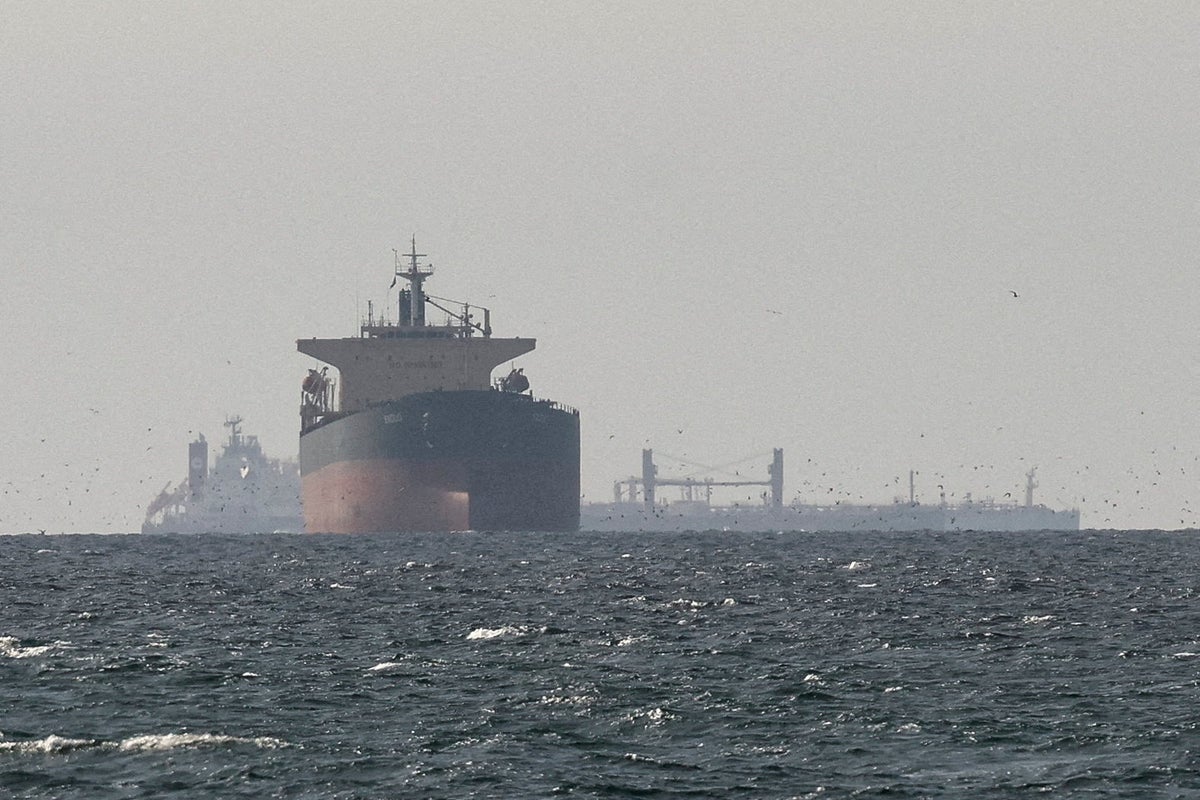
A single rusty tanker sits low in the water, heavy with two million barrels of crude oil. It moves through a narrow stretch of blue where the Persian Gulf meets the Gulf of Oman. The captain knows this stretch by heart. To his left, the jagged, sun-bleached cliffs of the Musandam Peninsula. To his right, the Iranian coast. At its narrowest, the shipping lane is only two miles wide.
This is the Strait of Hormuz. It is the jugular vein of the global economy.
One out of every five barrels of oil consumed on this planet passes through this tiny gap. If that flow stops, the world doesn't just slow down. It breaks. We often treat geopolitics like a chess match played by men in suits in Washington or Tehran, but for the family in a suburb of Ohio or a factory worker in Shanghai, the "Strait" isn't a map coordinate. It is the price of milk. It is the heat in the radiator. It is the difference between a paycheck and a pink slip.
As the current administration navigates the wreckage of the Iran nuclear deal and the shadow of renewed sanctions, a terrifying question hangs over the water: What happens if the U.S. leaves the table without a deal, and Iran decides to squeeze the vein?
The Ghost in the Machine
Consider Elias. He owns a small trucking fleet in the Midwest. He doesn't care about the intricacies of the JCPOA or the theological nuances of the Iranian Revolutionary Guard. But Elias lives on margins. When the price of diesel climbs by thirty cents, his profit vanishes. When it climbs by two dollars, he starts selling his trucks.
If the Strait of Hormuz closes, Elias becomes a ghost.
Economists call it a "supply shock," but that is a sterile term for a visceral tragedy. In the first scenario of a post-Trump exit without a maritime security deal, we face a Stagnant Squeeze. Iran doesn't have to sink a fleet. They only have to make the water feel dangerous.
Insurance premiums for tankers skyrocket overnight. Ship owners, wary of limpet mines or drone strikes, refuse to enter the Gulf. The oil is there, sitting in the sand, but it cannot reach the engines. The global market reacts with a frantic, animal panic. Crude prices don't just rise; they teleport. We are talking about $150 or $200 per barrel.
For Elias, this isn't a statistic. It’s the sound of silence in his dispatch office. It’s the realization that the global supply chain is a house of cards, and the wind is blowing from the coast of Bandar Abbas.
The Great Pivot
But perhaps the world finds a way to adapt. This is the second path: the Fractured Flow.
In this reality, the West finds itself sidelined. If the U.S. exits the region without a stabilizing agreement, a vacuum forms. Nature hates a vacuum, and so does Beijing. China imports more oil through the Strait than any other nation. If they perceive that Washington can no longer guarantee the safety of the lanes—or is actively destabilizing them through a "maximum pressure" campaign that lacks an exit ramp—they won't wait for permission to act.
Imagine a world where the security of the Persian Gulf is guaranteed not by the U.S. Fifth Fleet, but by a coalition led by China and Russia.
The human cost here is more subtle. It is the slow erosion of the dollar as the world’s reserve currency. For decades, the "Petrodollar" has allowed Americans to live beyond their means, subsidized by the fact that the world must buy dollars to buy oil. If the Strait becomes a Chinese-guaranteed waterway, the oil begins to trade in Yuan.
Suddenly, the American consumer feels a phantom pain. The cost of imported electronics, clothing, and medicine begins to creep upward. Not because of a strike or a shortage, but because the very money in their pocket has lost its magic. We become a nation watching from the shore as the center of gravity shifts East.
The Black Swan of Miscalculation
The most harrowing possibility is the one no one wants to name: The Kinetic Collapse.
History is littered with wars that no one intended to start. A nervous sonar operator, a misinterpreted radio transmission, or a rogue commander looking for glory. If the U.S. walks away from diplomacy and leaves the Strait in a state of permanent friction, the math of probability eventually catches up.
A single skirmish in the Strait leads to a total blockade. Iran has spent decades perfecting "asymmetric warfare." They don't need a traditional navy to win; they have thousands of fast-attack boats, sea mines, and shore-to-ship missiles hidden in the coastal mountains.
If the Strait closes entirely, the world loses 21 million barrels of oil per day instantly. There is no "Plan B." The pipelines across Saudi Arabia and the UAE can only handle a fraction of that volume.
The result is a global depression that makes 2008 look like a minor market correction. We are talking about food shortages in countries that rely on mechanized farming. We are talking about the collapse of the airline industry. We are talking about a world that suddenly feels very large, very dark, and very cold.
The Invisible Stakes
We tend to view these events through the lens of "victory" or "defeat." We want to know who "won" the negotiation. But in the waters of the Gulf, there is no such thing as a solitary win. We are all tethered to the same line.
The businessman in Dubai, the fisherman in Oman, the commuter in London, and the farmer in Iowa are all passengers on that same rusty tanker. When we talk about leaving Iran without a deal to keep the Strait open, we aren't just talking about foreign policy. We are talking about the precariousness of modern life.
We have built a civilization that requires a constant, rhythmic pulse of energy to survive. We have outsourced our stability to a two-mile-wide strip of water on the other side of the planet. To ignore the fragility of that connection is a form of collective madness.
The sun sets over the Musandam Peninsula, casting long, dark shadows across the water. The tanker continues its slow crawl toward the open sea. For now, the pulse remains steady. But the captain keeps his eyes on the horizon, knowing that the peace of the world depends on a balance so delicate that a single mistake, a single Tweet, or a single missed handshake could send the whole thing into the deep.
The lights of the coast flicker. Somewhere, a child flips a switch and a room glows. They don't know about the Strait. They don't know about the tankers. They just trust that the light will stay on. That trust is the most expensive commodity in the world, and right now, we are spending it faster than we can produce it.
Would you like me to look into the specific alternative pipeline projects currently being built to bypass the Strait?